How to Write YouTube Titles That Get More Clicks in 2026 (Complete Guide)
Stop losing views to boring headlines. Master the psychological triggers, SEO frameworks, and AI-driven strategies used by top creators to skyrocket your CTR and dominate the YouTube algorithm in 2026.
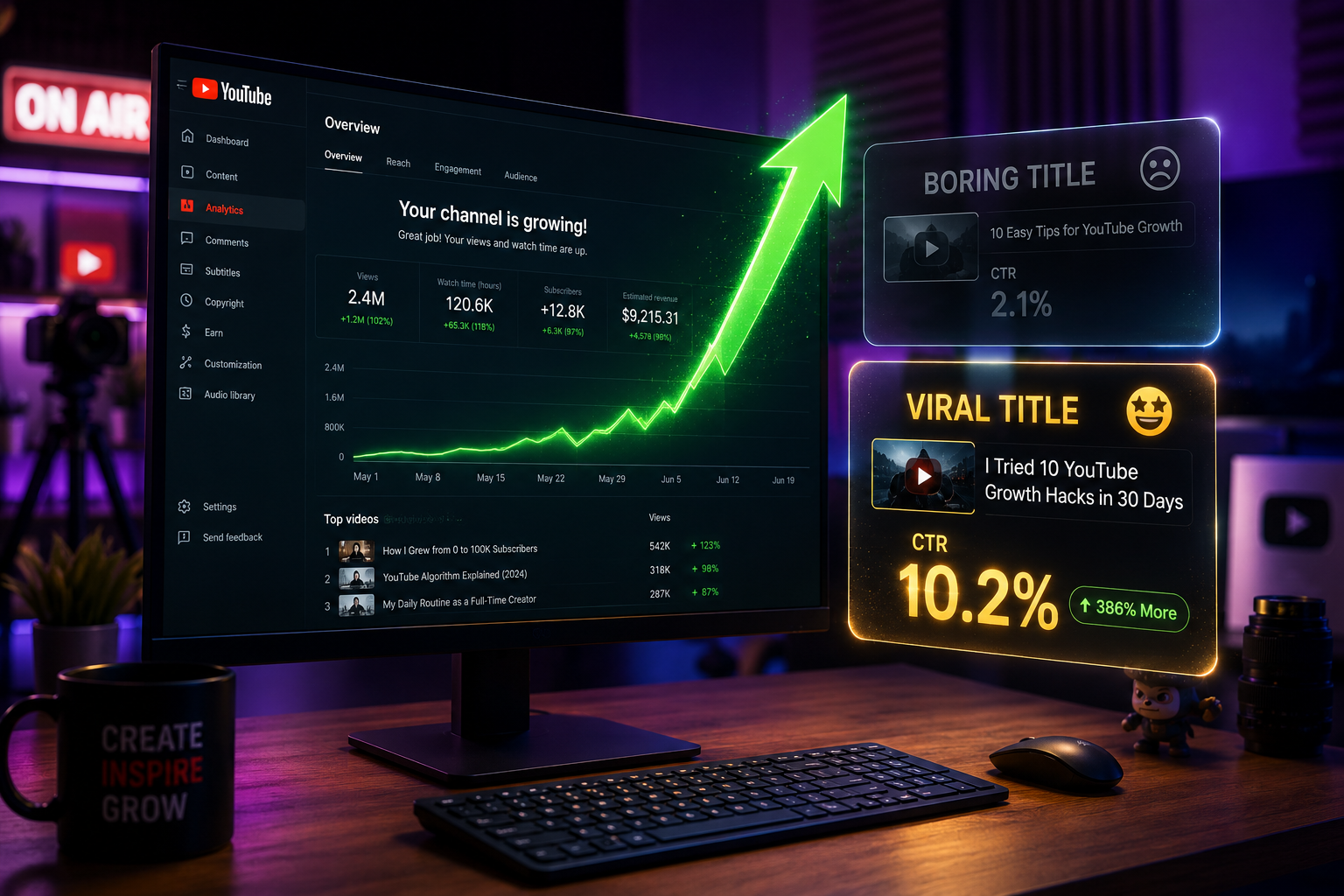
How to Write YouTube Titles That Get More Clicks in 2026 (Complete Guide + AI Tips)
Every second, a potential viewer scrolls past your video. They don't see your high-end editing or your expensive microphone. They see a thumbnail and a line of text.
In the creator economy of 2026, your title is your digital storefront. It is the primary psychological hook that determines whether your hard work is rewarded with a view or buried by the algorithm.
If you’ve ever felt like your content is "better" than your view count suggests, the problem isn't your quality—it’s your packaging. This guide will teach you the exact science of writing titles that demand attention.
Why YouTube Titles Matter More Than Ever in 2026
The landscape of online video has shifted. We are no longer in the era of simple keyword stuffing. Today, viewers are bombarded with more content than they could ever consume in a lifetime.
Search algorithms have evolved into "satisfaction engines." They no longer just look for what a video is about; they look for how a human reacts to it. A high Click-Through Rate (CTR) signals to the system that your video is the best answer to a user's curiosity.
Furthermore, mobile consumption is now the absolute standard. If your title doesn't capture attention in the first three words, it gets cut off by mobile truncation, and the click is lost forever.
Mini Summary
- Attention is Scarce: Titles are the filter that manages viewer overwhelm.
- CTR is King: High initial engagement tells the algorithm to "push" the video.
- Mobile First: Truncation means your most important words must come first.
How the YouTube Algorithm Uses Titles
In 2026, the algorithm functions as a matchmaker. It analyzes your title through three distinct lenses: Semantic Indexing, Intent Matching, and Behavioral Benchmarking.
First, it reads the text to categorize your content. It identifies keywords to know who might enjoy the video. Second, it matches the title against search queries to ensure relevance.
Finally—and most importantly—it measures how users behave. If the algorithm shows your video to 1,000 people and only 10 click, it assumes the video is irrelevant and stops promoting it. Your title is the lever that controls this distribution.
The Psychology Behind High CTR Titles
Great titles aren't written; they are engineered based on human biology. To get a click, you must trigger one of several deep-seated psychological responses.
The Curiosity Gap
This is the space between what a viewer knows and what they want to know. If you reveal the entire story in the title, there is no reason to click. By teasing a result without explaining the "how," you force the brain to seek closure.
Loss Aversion (FOMO)
Humans are biologically wired to avoid pain more than they seek pleasure. Titles that highlight a mistake, a warning, or a "hidden" truth perform exceptionally well because viewers don't want to feel left behind or uninformed.
The Transformation Promise
People watch YouTube to become a better version of themselves—richer, smarter, or more entertained. A title that promises a specific, measurable transformation creates an immediate value proposition.
Difference Between Good Titles and Great Titles
A "good" title is descriptive. It tells the viewer exactly what is in the video. A "great" title is provocative. It tells the viewer why the video matters to them.
Comparison Table 1: Bad Title vs Good Title
|
Video Topic |
Bad Title (Vague) |
Good Title (Descriptive) |
Great Title (High CTR) |
|
Cooking |
Making Steak |
How to Cook a Ribeye |
The Secret to a Perfect Steak (Better than Ruth's Chris) |
|
Finance |
My Stock Picks |
Best Stocks to Buy Now |
Why I’m Selling ALL My Stocks Tomorrow |
|
Tech |
iPhone 17 Review |
iPhone 17 Pro Max Review |
I Used the iPhone 17 for 30 Days (Don't Buy It Yet) |
|
Gaming |
Minecraft Day 10 |
Building a House in Minecraft |
I Built a Forbidden City in Minecraft Hardcore |
|
Fitness |
My Gym Routine |
How to Bench Press More |
This 5-Minute Fix Doubled My Bench Press |
15 Proven Strategies to Write Better YouTube Titles
1. Front-Load Your Primary Keyword
The first 40 characters are the most valuable real estate. Put your most important search term at the very beginning to ensure it’s seen on every device.
2. Aim for a Grade-Zero Reading Level
Data shows that the most viral videos (like those from MrBeast) use language that a 5th grader can understand. Avoid "maximizing" when you can use "growing."
3. Use the "1+1=3" Thumbnail Rule
Don't repeat the text that is on your thumbnail in your title. Use the title to provide context to the thumbnail's visual. If the thumbnail shows a broken car, the title should explain why it broke.
4. Leverage "I" and "You" Statements
Personalizing the title builds immediate rapport. "I tried this" creates a case study feel; "You need this" creates a direct command.
5. Incorporate Specific Numbers
Numbers provide a "cognitive anchor." "$1,243" feels more real and authentic than "thousands of dollars." Odd numbers often perform better than even ones.
6. Delete Vague Adjectives
Words like "amazing" or "incredible" have lost their meaning. Replace them with specific descriptors like "brutal," "illegal," or "instant."
7. Bracket Your Context
Adding [2026] or (Case Study) at the end of a title helps the viewer understand the format of the video before they click, reducing friction.
8. Use Monosyllabic Words
Short words are processed faster by the human brain. "Spent," "Built," "Won," and "Lost" are powerful because they require zero mental effort to read.
9. Create a Negative Hook
"Stop Doing This" almost always outperforms "Start Doing This." People are terrified of making mistakes.
10. Master the "Information Gap"
Tease the outcome. "The Real Reason [Subject] Failed" is a classic hook that works because it implies there is a secret the viewer doesn't know yet.
11. Capitalize One "Trigger" Word
Don't use all caps—it looks like spam. Instead, capitalize one word to draw the eye: "This is the ONLY way to grow."
12. Use Conversational Language
Write how people talk. If your title sounds like a textbook, people will treat it like homework and scroll past it.
13. Challenge the Status Quo
Contrarian titles stop the scroll. "Why Hard Work is a Lie" forces people to click because it contradicts what they believe.
14. Keep it Under 60 Characters
While you can use 100, the "sweet spot" is 40–60. This prevents the "..." truncation on mobile devices.
15. Mention a Timeframe
Adding "in 24 hours" or "for 30 days" adds stakes and a sense of urgency to the narrative.
Expert Tip: When you're stuck, you can generate 10+ variations of your hook using the free AI YouTube Title Copywriter on ZetaWala to see which angles you might be missing.
Common Mistakes Beginners Make
- Keyword Stuffing: Writing for robots instead of humans. "YouTube SEO 2026 SEO Tips YouTube Growth" is unreadable.
- Repeating the Thumbnail: Wasting space by typing what the viewer can already see in the image.
- Over-promising: If your title is "How to make $1 Million" and the video is about a $5 survey site, your retention will crash, and the algorithm will kill the video.
Warning Box:
Avoid "Red Flag" Words: Words like "Cure," "Hack," or excessive profanity can trigger the algorithm's safety filters, leading to shadow-banning or limited ads.
Examples of Bad vs Good Titles
- Bad: My Morning Routine (Too narcissistic for a new channel).
- Good: How to Be Productive in the Morning.
- Great: The 5 AM Routine That Saved My Business.
AI Tips for Writing Better Titles
AI shouldn't write your final title, but it should be your brainstorming partner.
- Ask for Formulas: Don't just ask for "a title." Ask for "5 titles using the 'Loss Aversion' framework."
- Constraint the AI: Tell the AI to keep suggestions under 50 characters.
- The "Human Polish": Take the AI's best idea and remove the "robotic" words like "Comprehensive," "Ultimate," or "Transformative."
Comparison Table 2: AI Titles vs Human Titles
|
Pure AI Output |
Human-Edited (Optimized) |
|
A Comprehensive Guide to Healthy Eating |
What I Ate to Lose 10lbs in 2 Weeks |
|
Maximizing Your Productivity with AI |
I Let AI Run My Life for 24 Hours |
|
The Future of Software Engineering |
Why I’m Quitting Software Engineering |
How to Test Different Titles
You no longer have to guess. YouTube Studio now includes a "Test & Compare" feature for A/B testing.
- Variation A: Search-focused (Keywords first).
- Variation B: Curiosity-focused (Emotional hook).
- Variation C: Narrative-focused ("I" statements).
Run the test for at least 3 days to get statistically significant data.
Best YouTube Title Formulas
- The "How To" with a Twist: How to [Goal] without [Pain Point]
- The Authority Statement: I am a [Expert]. Stop [Action]
- The Specific Result: How I made $[Amount] in [Time]
- The Warning: Don't [Action] until you see this
- The Mystery: The Secret [Subject] that [Benefit]
Power Words That Increase CTR
100 High CTR Power Words
Urgency:
Now, Fast, Instant, Today, Hurry, Last Chance, Deadline, Quick, Rapid, Sudden.
Curiosity:
Secret, Hidden, Banned, Illegal, Mystery, Forbidden, Confessions, Truth, Exposed, Underground.
Authority:
Proven, Expert, Official, Verified, Guaranteed, Masterclass, Blueprint, Formula, Logic, Science.
Emotion:
Shocking, Brutal, Heartbreaking, Life-changing, Worst, Best, Ugly, Beautiful, Scary, Dangerous.
Greed/Value:
Free, Wealth, Rich, Save, Million, Profit, Hack, Easy, Simple, Growth.
Words That Reduce CTR
Avoid "Academic" or "Corporate" words. They create friction.
- Comprehensive
- Utilize
- Methodology
- Introduction
- Part 1 (Unless it’s a very established series)
Best Character Length
Comparison Table 3: Short vs Long Titles
|
Feature |
Short (< 30 Chars) |
Ideal (40 - 60 Chars) |
Long (> 70 Chars) |
|
Visibility |
100% |
100% |
Cut off on mobile |
|
Context |
Low |
High |
Very High |
|
SEO Weight |
Focused |
Balanced |
Diluted |
Should You Use Emojis?
Yes—but only one. A single 🚀 or ⚠️ can act as a visual disruptor in a text-heavy feed. Two or more looks like spam.
Should You Use Numbers?
Absolutely. Numbers act as a "mental shortcut."
- Bad: How I saved money.
- Good: How I saved $4,203.
Question Titles vs Statement Titles
Comparison Table 4: Question vs Statement
|
Feature |
Question Title |
Statement Title |
|
Trigger |
Curiosity/Search |
Authority/Browse |
|
Goal |
Make them answer |
Make them listen |
|
Example |
Is AI Killing Coding? |
AI Just Killed Coding. |
Title + Thumbnail Relationship
The most important concept is Congruence. If the thumbnail shows a face looking shocked, the title must explain what the shock is about. If they don't match, the viewer feels "tricked" and won't click.
YouTube SEO Best Practices
- Research Intent: Use search suggest to find what people are actually typing.
- Consistent Metadata: Your title, tags, and description should all point to the same "Entity."
- Front-Load: Put the keyword in the first 3 words.
Case Study Examples
MrBeast: Uses ultra-simple words. "I Spent 50 Hours In Solitary Confinement." No big words. High stakes.
Ali Abdaal: Uses "The 1+1=3" rule. Thumbnail: "I'm Quitting." Title: "Why I'm leaving my $5M Business."
25 Practical Title Examples Across Niches
- I Tried [Product] for 30 Days (The Truth)
- Why I’m Quitting [Industry] in 2026
- 7 Mistakes Beginners Make in [Niche]
- How to [Task] in 10 Minutes
- The Secret to [Result] Finally Revealed
- Stop [Action] Before You [Result]
- I Built a [Product] for Under $100
- [Expert] Reacts to [Viral Event]
- Is [Topic] Actually Dead?
- The Brutal Reality of [Lifestyle]
50 Ready-to-Use YouTube Title Templates
- How to [Action] like a Pro (Even if you’re a beginner)
- The ONLY [Niche] Guide you need in 2026
- I regret buying the [Product]... here’s why
- [Number] Hacks to double your [Result]
- What happens if you [Action] for a week?
Free YouTube Title Checklist
- [ ] Is the primary keyword in the first 40 characters?
- [ ] Is it under 60 characters total?
- [ ] Does it create a "Curiosity Gap"?
- [ ] Have I removed all "robotic" or vague adjectives?
- [ ] Does it complement (not repeat) the thumbnail?
- [ ] Is there a number or a power word included?
FAQs
- Does changing a title reset the algorithm? No, but it triggers a re-evaluation of your CTR.
- Are ALL CAPS okay? Use them for one word, not the whole title.
- How long should I wait before changing a title? 24-48 hours if the CTR is below your channel average.
- Do emojis help SEO? No, they help CTR, which then helps SEO.
- Should I put my name in the title? Only if you are a major celebrity. Otherwise, it’s wasted space.
Final Thoughts
Writing titles is a skill, not a talent. By focusing on the psychology of the viewer rather than the mechanics of the search engine, you can unlock growth you never thought possible. Remember: Every click is a person deciding you have something worth their time. Respect that attention, and the algorithm will reward you.
Internal Linking & Tools
- Generate your next viral hook: YouTube Video Idea Generator
- Master your intro: Audience Retention Hook Generator
- Automate your SEO: SEO Description Writer
- Get the right metadata: Tags & Keyword Extractor
- Design better visuals: AI Thumbnail Prompter
- Write scripts that convert: Comprehensive Script Writer
Written by
Zahid Jamali
Founder of Zetawala
AI SEO Researcher
Discussion (0)
No comments yet. Start the conversation!