YouTube Automation in 2026: The Complete Beginner's Guide to Building a Successful Faceless Channel
Discover everything you need to know about YouTube automation in 2026. Learn how successful creators use AI, SEO, and efficient workflows to build and grow profitable faceless YouTube channels. From choosing the right niche to optimizing videos for search, this comprehensive guide covers practical strategies, essential tools, and expert tips to help you create high-quality content and scale your channel with confidence.
YouTube Automation in 2026: The Complete Beginner's Guide to Building a Faceless YouTube Business
Imagine earning money from YouTube without appearing on camera, recording your own voice, or spending hours editing videos every week. Just a few years ago, this sounded unrealistic. Today, it has become one of the fastest-growing content creation models on the internet.
This approach is known as YouTube automation.
Despite the name, YouTube automation doesn't mean pressing a single button and watching money appear in your bank account. Instead, it is a strategic way of building and managing a YouTube channel by creating repeatable workflows, using modern tools, and outsourcing time-consuming tasks while maintaining high-quality content.
Whether you're a student looking for an extra income stream, a freelancer searching for a scalable business, an entrepreneur building digital assets, or simply someone interested in creating a faceless YouTube channel, understanding how YouTube automation works is the first step toward long-term success.
The popularity of AI-powered content creation, advanced video editing software, and cloud-based collaboration tools has made YouTube automation more accessible than ever before. However, increased accessibility has also led to more competition. Channels that rely on low-quality, mass-produced content are finding it harder to grow, while creators who focus on value, originality, and audience satisfaction continue to build sustainable businesses.
The good news is that you don't need a large team or expensive software to get started. With the right strategy, a clear workflow, and reliable tools, even a single creator can launch and manage multiple YouTube channels successfully.
In this comprehensive guide, you'll learn exactly what YouTube automation is, how it works, what tools you need, common mistakes to avoid, and the proven strategies that successful creators use to build channels that continue attracting viewers month after month.
If you're serious about building a professional YouTube automation business, this guide will help you understand not just the concept but the complete process behind creating a successful faceless YouTube channel.
Table of Contents
- What Is YouTube Automation?
- How Does YouTube Automation Work?
- Is YouTube Automation Really Automated?
- Benefits of Starting a YouTube Automation Channel
- Common Myths About YouTube Automation
- Step-by-Step Workflow for Building a YouTube Automation Channel
- Best YouTube Automation Tools
- How AI Is Changing YouTube Automation
- Choosing a Profitable Niche
- SEO Tips for YouTube Automation Success
- Common Mistakes Beginners Make
- Is YouTube Automation Worth It in 2026?
- Frequently Asked Questions
What Is YouTube Automation?
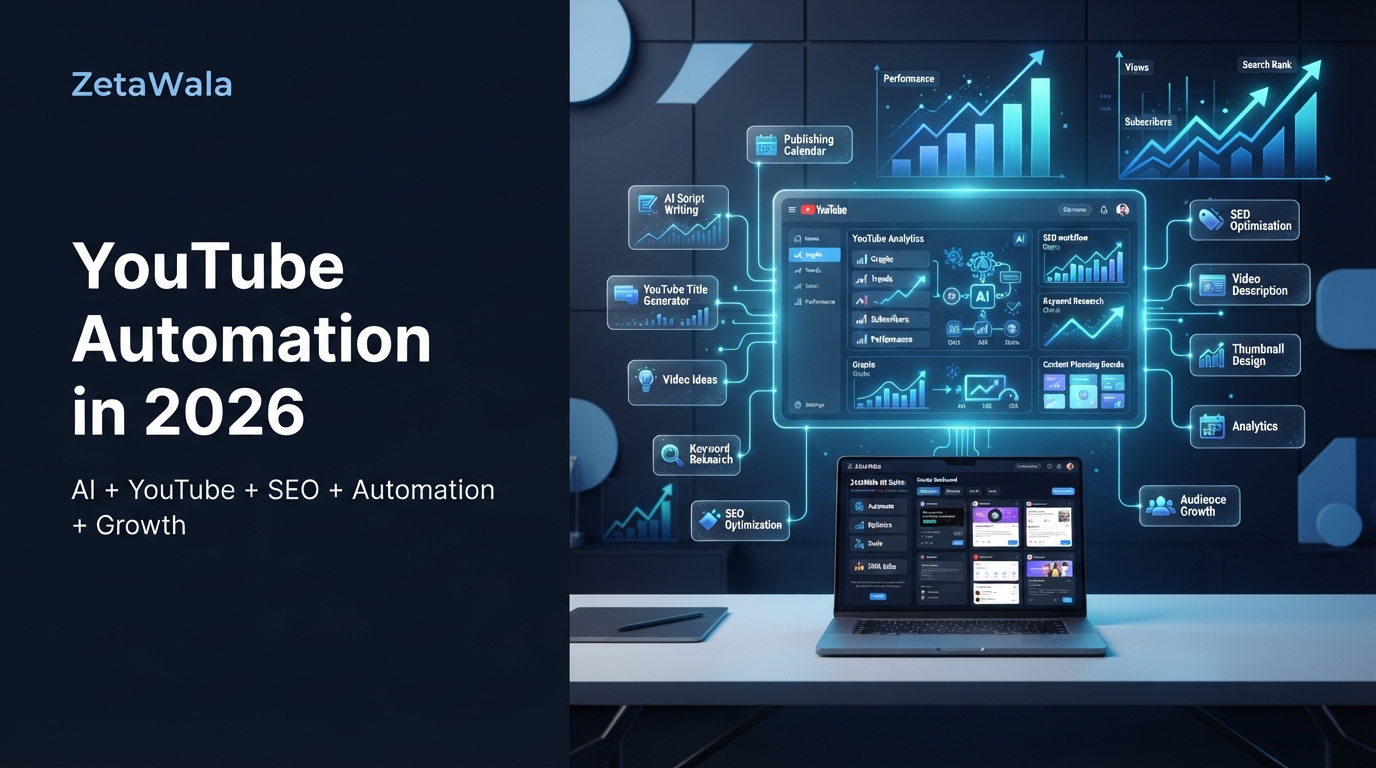
YouTube automation is a content creation and channel management strategy where repetitive tasks are streamlined through systems, software, AI-powered tools, or outsourced professionals. Instead of doing every task yourself, you create an efficient workflow that allows your channel to produce high-quality videos consistently.
A typical YouTube automation workflow includes:
- Finding trending topics and validating audience demand
- Conducting keyword research for YouTube SEO
- Generating engaging video ideas
- Writing compelling scripts
- Creating attention-grabbing titles
- Designing clickable thumbnails
- Editing videos professionally
- Optimizing descriptions, tags, and chapters
- Publishing videos on a consistent schedule
- Monitoring analytics to improve future content
The important thing to understand is that automation does not replace creativity. Successful channels still rely on original research, valuable insights, engaging storytelling, and a deep understanding of their audience. Automation simply removes repetitive work so creators can spend more time producing content that people genuinely enjoy watching.
Many successful faceless YouTube channels operate this way. Some creators handle research themselves while outsourcing editing, voiceovers, or thumbnail design. Others use AI to speed up brainstorming and drafting before refining every piece of content manually. The exact workflow depends on your budget, experience, and goals.
Today, AI has made YouTube automation even more efficient. Modern tools can assist with brainstorming ideas, drafting scripts, generating SEO-friendly titles, creating optimized descriptions, suggesting tags, and analyzing trends. Used responsibly, these tools can save hours of work without compromising originality or quality.
At ZetaWala, we're building practical AI-powered tools designed specifically to simplify this workflow. From generating engaging YouTube titles and well-structured scripts to creating optimized descriptions, tags, and content ideas, our goal is to help creators work smarter while keeping originality and quality at the center of every video.
It's worth remembering that YouTube rewards videos that deliver value to viewers—not channels that use the most automation. No software can replace thoughtful content, genuine expertise, and a clear understanding of what your audience wants. Automation is simply a way to improve efficiency, allowing creators to focus on producing videos that people choose to watch, enjoy, and share.
How Does YouTube Automation Work?
At its core, YouTube automation is about creating a repeatable system for producing high-quality videos efficiently. Instead of treating every upload as a completely new project, successful creators build a workflow that can be repeated, improved, and scaled over time.
Contrary to what many beginners believe, YouTube automation isn't about letting artificial intelligence create hundreds of videos without supervision. The most successful channels combine human creativity with smart tools to reduce repetitive work while maintaining originality and quality.
A well-structured YouTube automation workflow generally consists of the following stages.
Step 1: Choose a Profitable Niche
Every successful YouTube automation channel starts with selecting the right niche. A profitable niche isn't just one with millions of views—it should also have consistent audience demand, monetization potential, and enough content opportunities to support long-term growth.
Some of the most popular YouTube automation niches include:
- Personal finance
- Technology
- Artificial intelligence
- Business and entrepreneurship
- History
- Documentaries
- Space exploration
- Psychology
- Self-improvement
- Luxury lifestyle
- Health and fitness
- Educational content
Rather than chasing every trending topic, focus on building authority within one niche. This helps YouTube better understand your content and recommend your videos to the right audience.
Pro Tip: Before selecting a niche, study the competition, search demand, advertiser interest, and upload consistency of successful channels.
Step 2: Research Topics That People Actually Search For
Publishing videos without understanding what your audience wants is one of the biggest reasons new channels struggle.
Instead of guessing, successful creators research:
- Trending topics
- Frequently searched questions
- Competitor videos
- Audience comments
- Seasonal trends
- Emerging news
- Keyword search volume
The goal is to identify topics that have strong interest but still provide room for your unique perspective.
For example, instead of creating a generic video about AI, you might cover:
- Best AI tools for students
- AI business ideas
- AI automation for beginners
- Free AI software in 2026
Specific topics often perform better because they answer a clear user intent.
Step 3: Perform YouTube Keyword Research
YouTube is the world's second-largest search engine, which makes keyword research just as important as it is for traditional SEO.
Choosing the right keywords helps your videos appear in YouTube search results, suggested videos, and even Google Search.
When researching keywords, consider:
- Search volume
- Competition level
- Viewer intent
- Click potential
- Trending phrases
- Long-tail keywords
Rather than targeting only broad keywords like YouTube automation, successful creators also optimize for related searches such as:
- YouTube automation for beginners
- Faceless YouTube channel ideas
- YouTube automation business
- AI YouTube tools
- Best YouTube automation software
These variations help capture a wider range of search traffic while making your content more relevant to different audiences.
Step 4: Write an Engaging Script
A strong script is the foundation of every successful YouTube video.
No amount of editing, animation, or visual effects can compensate for weak storytelling.
An effective script usually follows this structure:
- A compelling hook that grabs attention within the first few seconds.
- A clear introduction explaining what viewers will learn.
- Well-organized sections that provide useful information.
- Real examples or supporting evidence.
- A concise conclusion with a clear call to action.
Many creators now use AI tools to generate initial drafts, but the best-performing channels always edit and refine those drafts to match their voice and ensure factual accuracy.
This approach saves time without sacrificing quality.
Step 5: Record the Voiceover
Once the script is complete, the next step is recording the narration.
There are several approaches:
- Record your own voice.
- Hire a professional voice artist.
- Work with freelance narrators.
- Use high-quality AI voice generators where appropriate.
Regardless of the method you choose, clarity, pacing, pronunciation, and emotion play a major role in viewer retention.
A great voiceover keeps people watching.
Step 6: Create the Video
Video production combines the script, voiceover, visuals, background music, transitions, animations, and captions into a polished final product.
Depending on your niche, visuals may include:
- Stock footage
- Motion graphics
- Screen recordings
- Infographics
- Animations
- Historical images
- Maps
- Charts
- Licensed media
The objective isn't to overload viewers with effects but to support the story visually and maintain engagement throughout the video.
Step 7: Design a High-Click Thumbnail
Your thumbnail is often the deciding factor between someone clicking your video or scrolling past it.
An effective thumbnail typically includes:
- A clear focal point
- Minimal text
- Strong contrast
- High-quality visuals
- Emotional appeal
- Curiosity
Remember, even the best video won't perform well if nobody clicks on it.
Step 8: Optimize Your Video for YouTube SEO
Publishing isn't the final step.
Before making a video public, optimize every element that influences discoverability.
This includes:
- SEO-friendly title
- Keyword-rich description
- Relevant tags
- Video chapters
- Hashtags
- Closed captions
- End screens
- Cards
- Playlist placement
These optimizations help YouTube understand your content and recommend it to the right viewers.
As ZetaWala continues to expand, you'll be able to simplify many of these optimization tasks using dedicated tools for generating SEO-friendly titles, engaging descriptions, relevant tags, and content ideas—all designed to help creators save time while following YouTube SEO best practices.
Step 9: Publish Consistently
Many channels fail not because their content is poor, but because they upload inconsistently.
Consistency sends positive signals to both viewers and YouTube's recommendation system.
Whether you publish:
- once a week,
- twice a week,
- or every day,
choose a realistic schedule that you can maintain over the long term.
Quality and consistency always outperform short bursts of uploads followed by long periods of inactivity.
Step 10: Analyze, Learn, and Improve
The workflow doesn't end after publishing.
Successful YouTube automation channels constantly review their analytics to understand what works and what doesn't.
Pay close attention to metrics such as:
- Click-through rate (CTR)
- Average view duration
- Audience retention
- Watch time
- Subscriber growth
- Returning viewers
- Traffic sources
- Engagement rate
These insights reveal valuable patterns that help you refine future videos, improve viewer satisfaction, and increase long-term channel growth.
Is YouTube Automation Really Automated?
One of the biggest misconceptions is that YouTube automation means creating a channel that runs entirely on autopilot.
In reality, successful YouTube automation is systemized—not fully automated.
Artificial intelligence can help brainstorm ideas, speed up research, draft scripts, generate titles, and assist with SEO. Freelancers can handle editing, voiceovers, or thumbnail design. Project management tools can streamline collaboration.
But the strategy behind the channel—choosing the right topics, understanding your audience, maintaining quality standards, and continuously improving based on analytics—still requires human judgment.
Think of automation as an assistant rather than a replacement. The creators who combine efficient workflows with originality and audience-focused content are the ones most likely to build channels that continue growing year after year.
Benefits, Challenges, and Common Myths of YouTube Automation
By now, you should have a clear understanding of what YouTube automation is and how the workflow operates. The next question most beginners ask is whether it's actually worth investing time and effort into.
The answer depends on your expectations. YouTube automation is not a shortcut to overnight success, but when approached strategically, it can become a scalable and sustainable content business.
Let's look at both the advantages and the realities.
Benefits of YouTube Automation
1. Build a Business Without Appearing on Camera
One of the biggest reasons people choose YouTube automation is the ability to create valuable content without becoming a public personality.
If you're camera-shy, value your privacy, or simply prefer working behind the scenes, a faceless YouTube channel allows you to focus on research, storytelling, and production rather than personal branding.
Many successful channels have built loyal audiences without viewers ever knowing who runs them.
2. Create a Scalable Workflow
Traditional content creation often relies on one person doing everything—from researching ideas to editing videos.
With YouTube automation, you can break the process into repeatable tasks. As your channel grows, you can gradually delegate specific responsibilities such as editing, voiceovers, or thumbnail design while maintaining quality standards.
This makes it easier to produce content consistently without becoming overwhelmed.
3. Save Time with AI and Smart Tools
Modern AI tools can significantly reduce the time spent on repetitive tasks.
For example, they can help you:
- Brainstorm fresh video ideas
- Draft structured scripts
- Generate SEO-friendly titles
- Write optimized descriptions
- Suggest relevant tags
- Organize content outlines
These tools are designed to assist—not replace—your creativity. Reviewing, refining, and adding your own perspective remains essential for producing content that stands out.
As ZetaWala expands its YouTube toolkit, creators will have access to purpose-built tools that simplify these tasks while keeping quality and originality at the forefront.
4. Diversify Your Income
A successful YouTube channel can generate revenue from multiple sources, including:
- YouTube Partner Program (Ad Revenue)
- Brand sponsorships
- Affiliate marketing
- Digital product sales
- Online courses
- Memberships
- Merchandise
- Consulting or freelance opportunities
Relying on multiple income streams can make your business more resilient than depending on advertising alone.
5. Build a Long-Term Digital Asset
Unlike social media posts that often disappear from attention within days, YouTube videos can continue attracting views months or even years after publication.
Evergreen videos that answer common questions or solve specific problems can consistently bring new viewers to your channel, making YouTube one of the strongest long-term content platforms.
Challenges You Should Be Aware Of
While YouTube automation offers many advantages, it's important to understand the challenges before getting started.
Competition Is Increasing
More creators are entering the YouTube automation space every year. Standing out requires originality, useful content, and a clear understanding of your audience—not simply publishing more videos.
Quality Matters More Than Quantity
Uploading dozens of low-value videos is unlikely to produce meaningful results.
YouTube's recommendation system increasingly rewards content that keeps viewers engaged, delivers value, and encourages people to return.
Publishing one excellent video is often more effective than publishing several average ones.
Consistency Requires Commitment
Even with AI tools and automation, successful channels require planning, research, and regular publishing.
Building an audience is usually a gradual process. Patience and consistency are far more valuable than chasing quick results.
You Must Follow YouTube's Policies
Using copyrighted footage, misleading thumbnails, spammy SEO techniques, or repetitive AI-generated content without proper editing can lead to reduced reach or other issues.
Always create original content, respect copyright laws, and follow YouTube's Community Guidelines and monetization policies.
Common Myths About YouTube Automation
As YouTube automation has become more popular, so have the misconceptions surrounding it. Let's clear up some of the most common myths.
Myth 1: "Everything Is Fully Automated"
Reality: Successful channels still require human decision-making.
AI can assist with brainstorming, drafting, and optimization, but choosing the right topics, verifying information, improving storytelling, and understanding audience preferences remain human responsibilities.
Myth 2: "You Need a Large Team"
Reality: Many creators begin entirely on their own.
You don't need editors, designers, or voice artists on day one. As your channel grows, you can outsource specific tasks based on your budget and needs.
Myth 3: "AI Can Replace Creativity"
Reality: AI is most effective when used as a productivity assistant.
The channels that perform best combine AI-powered efficiency with original ideas, thoughtful editing, and a unique perspective that resonates with viewers.
Myth 4: "YouTube Automation Is Easy Money"
Reality: Building a successful channel takes time.
Behind every thriving YouTube automation business are hours of research, planning, scripting, optimization, testing, and continuous learning.
Treat it like a real business rather than a shortcut, and you'll be far more likely to achieve sustainable results.
Key Takeaway
YouTube automation is best viewed as a system for working smarter—not a promise of effortless success. The combination of quality content, audience-focused strategy, consistent publishing, and efficient workflows creates the strongest foundation for long-term growth.
Whether you're managing your first channel or planning to build multiple faceless brands, success comes from delivering genuine value to viewers. Automation and AI can accelerate your workflow, but they're most powerful when paired with creativity, originality, and a commitment to continuous improvement.
Best YouTube Automation Tools in 2026
Building a successful YouTube automation channel doesn't require dozens of expensive subscriptions. In fact, many creators achieve excellent results by using a carefully selected toolkit that helps them research topics, create engaging content, optimize videos for search, and improve their workflow.
The key is choosing tools that save time without compromising quality. Every piece of content should still be reviewed, refined, and tailored to your audience.
Below are the essential categories of tools that can help streamline your YouTube automation workflow.
1. Content Research and Idea Generation
Every successful video starts with a strong idea.
Instead of randomly choosing topics, use research tools to understand what your audience is searching for and which subjects are gaining momentum.
Look for tools that help you:
- Discover trending topics
- Find frequently asked questions
- Analyze competitors
- Identify content gaps
- Validate audience demand
- Organize future content ideas
A well-planned content strategy often outperforms simply following viral trends.
2. YouTube Keyword Research Tools
YouTube functions as a search engine, making keyword research an essential part of every publishing strategy.
Good keyword research tools help you identify phrases your target audience is actively searching for while estimating competition and search intent.
Focus on finding:
- Primary keywords
- Long-tail keywords
- Question-based searches
- Related keyword variations
- Seasonal opportunities
Optimizing your videos around relevant keywords increases the likelihood of appearing in YouTube Search, Suggested Videos, and even Google Search results.
3. AI Script Writing Tools
Writing engaging scripts consistently can become challenging, especially as your upload schedule grows.
AI-assisted writing tools can help generate:
- Video outlines
- Opening hooks
- Script drafts
- Section summaries
- Calls to action
However, AI-generated content should always be reviewed for accuracy, tone, and originality. The best-performing channels use AI as a starting point rather than publishing raw outputs.
Adding personal insights, examples, and a conversational tone makes your content more engaging and trustworthy.
4. YouTube Title Generators
Your title is one of the first things potential viewers notice.
A compelling title should:
- Clearly explain the video's value
- Spark curiosity
- Include your target keyword naturally
- Avoid misleading clickbait
Well-crafted titles improve click-through rates while setting accurate expectations for viewers.
5. Thumbnail Design Tools
Even exceptional videos can struggle if their thumbnails fail to capture attention.
Effective thumbnail design tools can help you create visuals that are:
- Clean and easy to understand
- High contrast
- Mobile-friendly
- Emotionally engaging
- Consistent with your brand
Remember, thumbnails and titles work together. One supports the other in encouraging viewers to click.
6. Video Editing Software
Editing is where your script, narration, and visuals come together.
Whether you're creating educational videos, documentaries, tutorials, or list-based content, a polished editing process improves viewer retention and professionalism.
A good editor allows you to:
- Trim unnecessary footage
- Add transitions
- Include captions
- Insert animations
- Improve pacing
- Enhance audio quality
The goal isn't flashy editing—it's keeping viewers engaged from beginning to end.
7. AI Voice Generation
Not everyone is comfortable recording their own voice.
Modern AI voice technology has improved significantly and can produce natural-sounding narration suitable for many educational and informational videos.
If you use AI voices, prioritize:
- Natural pronunciation
- Appropriate pacing
- Emotional variation
- Clear articulation
For some niches, using your own voice or hiring a professional narrator may still create a stronger connection with viewers.
8. SEO Optimization Tools
Publishing a video without optimization means missing valuable opportunities for discoverability.
SEO tools can assist with:
- Optimized titles
- Detailed descriptions
- Relevant tags
- Hashtag suggestions
- Video chapters
- Keyword placement
While optimization alone won't make a video successful, it helps search engines better understand your content and connect it with the right audience.
9. Analytics and Performance Tracking
Growth comes from learning what works.
Regularly reviewing your channel's performance helps you identify successful topics, improve weaker videos, and make better content decisions over time.
Key metrics include:
- Click-through rate (CTR)
- Watch time
- Audience retention
- Subscriber growth
- Returning viewers
- Traffic sources
- Engagement metrics
Successful creators treat analytics as a roadmap for continuous improvement rather than simply checking view counts.
Why an Integrated Workflow Matters
Many creators switch between multiple websites and applications just to complete a single video.
For example, they may use one platform for keyword research, another for script writing, a third for title generation, and several more for descriptions, tags, and content planning.
This fragmented workflow increases complexity and wastes valuable time.
An integrated workflow allows creators to focus less on managing tools and more on producing high-quality content.
How ZetaWala Simplifies YouTube Automation
At ZetaWala, our goal is to simplify the YouTube content creation process by bringing essential creator tools together in one platform.
Instead of relying on multiple disconnected services, creators will be able to access a growing collection of AI-assisted tools designed specifically for YouTube creators, including:
- AI YouTube Title Generator
- AI Script Generator
- YouTube Description Generator
- YouTube Tag Generator
- Video Idea Generator
- AI Hook Generator
- YouTube Keyword Research Tool
- Channel Name Generator
- Thumbnail Idea Generator
- Content Planning Tools
Each tool is designed to help reduce repetitive work while encouraging creators to produce original, audience-focused content.
Whether you're launching your first faceless YouTube channel or managing multiple content brands, ZetaWala aims to become your all-in-one productivity hub for YouTube automation.
As we continue expanding the platform, new features and optimization tools will be added to support creators at every stage of their journey.
Choosing the Right Tools
The best YouTube automation toolkit isn't necessarily the one with the most features—it's the one that fits your workflow and helps you create better content consistently.
Start with the essentials:
- A reliable research process
- Effective keyword planning
- High-quality script writing
- Strong thumbnails
- SEO optimization
- Performance analysis
As your channel grows, you can gradually expand your toolkit and automate more repetitive tasks without sacrificing quality.
Remember, tools don't make videos successful—great ideas, valuable content, and a deep understanding of your audience do. The right tools simply help you execute those ideas more efficiently.
YouTube SEO Strategy for Automation Channels
Creating a high-quality video is only half the job. If people can't find your content, even the most informative or entertaining videos may struggle to gain traction.
This is where YouTube SEO (Search Engine Optimization) becomes essential.
YouTube's algorithm is designed to recommend videos that are relevant, engaging, and valuable to viewers. By optimizing your content for search and recommendations, you improve the chances of reaching the right audience organically.
The good news is that effective YouTube SEO isn't about manipulating the algorithm—it's about making it easier for YouTube to understand your content and confidently recommend it to people who are likely to enjoy it.
Let's explore the strategies that successful YouTube automation channels use to grow consistently.
1. Start with Search Intent, Not Just Keywords
One of the biggest SEO mistakes beginners make is targeting keywords without understanding why people are searching for them.
Every search has an intent. Before creating a video, ask yourself:
- Is the viewer trying to learn something?
- Are they looking for a solution to a problem?
- Do they want a product recommendation?
- Are they comparing different options?
- Are they searching for the latest news or trends?
When your video fully satisfies the viewer's intent, it has a much better chance of earning longer watch times, stronger engagement, and higher rankings.
Always create videos for people first and algorithms second.
2. Choose Keywords Naturally
Keywords remain an important ranking factor, but keyword stuffing does more harm than good.
Include your primary keyword naturally in:
- The video title
- The first paragraph of the description
- Spoken dialogue where appropriate
- Closed captions
- File naming (before uploading)
- Chapters, when relevant
Also include related phrases and variations throughout your content. This helps YouTube understand the broader topic of your video.
For example, if your target keyword is YouTube automation, naturally mention related concepts such as faceless YouTube channels, AI content creation, YouTube workflow, video optimization, and channel growth.
3. Write Titles That Earn Clicks
Your title directly influences your click-through rate (CTR), which is one of the strongest indicators of whether viewers find your content appealing.
An effective title should:
- Clearly communicate the video's value
- Spark curiosity without being misleading
- Include the primary keyword naturally
- Be concise and easy to read
- Set accurate expectations
Avoid exaggerated promises that your video cannot fulfill. Misleading titles may increase clicks initially but often lead to lower audience retention and reduced trust.
4. Optimize Your Video Description
Many creators overlook the video description, but it provides valuable context for both YouTube and viewers.
A well-written description should:
- Summarize the video's main topic
- Include your primary keyword naturally
- Mention related keywords where relevant
- Add useful timestamps or chapters
- Link to helpful resources
- Include a clear call to action
Rather than writing for search engines, focus on providing information that genuinely helps viewers understand what your video offers.
5. Design Thumbnails That Match Your Content
Thumbnails and titles work together.
A compelling thumbnail attracts attention, while the title explains why someone should click.
Some best practices include:
- Keep the design clean and uncluttered.
- Use readable text sparingly.
- Highlight a single focal point.
- Maintain consistent branding.
- Ensure the thumbnail remains clear on mobile devices.
The goal is to encourage clicks through relevance and curiosity—not through deception.
6. Increase Audience Retention
One of the strongest signals YouTube considers is how long viewers continue watching.
To improve audience retention:
- Start with a compelling hook.
- Deliver value early.
- Remove unnecessary introductions.
- Maintain a steady pace.
- Use visuals that support the narration.
- Keep transitions smooth.
- Avoid repetitive sections.
Every second should encourage viewers to continue watching.
A video with excellent retention often outperforms a longer video that loses viewers quickly.
7. Encourage Meaningful Engagement
Likes, comments, shares, and subscriptions aren't just vanity metrics—they indicate that viewers found your content valuable.
Encourage engagement naturally by asking thoughtful questions, inviting feedback, or prompting viewers to share their experiences.
Avoid repeatedly asking for likes or subscriptions throughout the video. A single, genuine call to action is usually more effective.
8. Organize Videos into Playlists
Playlists help viewers discover related content and encourage longer viewing sessions.
For example, if your channel focuses on YouTube automation, you could organize videos into playlists such as:
- YouTube Automation for Beginners
- YouTube SEO
- AI Tools for Creators
- Faceless Channel Strategies
- Monetization Tips
Well-structured playlists improve the user experience while increasing overall watch time across your channel.
9. Publish Consistently
Consistency helps build audience expectations and provides YouTube with a regular stream of fresh content.
Choose an upload schedule that matches your resources.
Whether you publish once a week or three times a week, consistency is generally more effective than uploading frequently for a short period and then disappearing.
10. Monitor Analytics and Improve Continuously
SEO is not a one-time task.
After publishing each video, review your analytics to understand what worked well and where improvements can be made.
Pay attention to:
- Click-through rate (CTR)
- Average view duration
- Audience retention
- Watch time
- Subscriber growth
- Returning viewers
- Traffic sources
- Search queries
Use these insights to refine future topics, improve thumbnails, strengthen hooks, and better understand your audience's preferences.
Over time, small improvements can lead to significant channel growth.
How ZetaWala Helps You Optimize for YouTube SEO
Managing YouTube SEO manually can become time-consuming, especially as your content library grows.
That's why we're building ZetaWala to simplify the optimization process for creators.
Our growing suite of AI-assisted tools is designed to help you:
- Generate SEO-friendly YouTube titles
- Write engaging video descriptions
- Discover relevant keyword ideas
- Create optimized tags
- Brainstorm compelling hooks
- Generate content ideas
- Plan future videos more efficiently
Rather than replacing your creativity, these tools are designed to support your workflow, reduce repetitive tasks, and help you focus on creating content that provides genuine value to your audience.
Whether you're launching your first channel or scaling an established one, ZetaWala aims to become your trusted companion for smarter, more efficient YouTube content creation.
The Bottom Line
There is no secret formula for ranking on YouTube.
The channels that consistently succeed are those that understand their audience, create valuable content, optimize it thoughtfully, and improve with every upload.
SEO is not about chasing algorithms—it's about helping the right viewers discover content they'll genuinely appreciate.
When you combine high-quality content with effective optimization and a consistent publishing strategy, you're giving your channel the best possible opportunity for long-term, sustainable growth.
Common Mistakes to Avoid, Is YouTube Automation Worth It in 2026, FAQs, and Final Thoughts
Starting a YouTube automation channel is easier today than it has ever been before, but building a successful one still requires patience, consistency, and a willingness to learn.
Many creators don't struggle because YouTube automation doesn't work—they struggle because they make avoidable mistakes early in their journey.
Understanding these challenges before you begin can save you months of frustration and help you build a stronger foundation.
Common Mistakes Beginners Make
1. Choosing a Niche Only Because It's Trending
One of the most common mistakes is selecting a niche simply because someone else is succeeding in it.
A trending niche may generate millions of views today, but if you have little interest in the topic or can't consistently produce valuable content, maintaining the channel becomes difficult.
Instead, choose a niche that balances:
- Audience demand
- Long-term growth potential
- Monetization opportunities
- Your genuine interest and knowledge
Consistency is much easier when you enjoy the subject you're creating content about.
2. Focusing on Quantity Instead of Quality
Publishing more videos doesn't automatically lead to more views.
One well-researched, engaging, and professionally optimized video often performs better than several rushed uploads.
Before publishing, ask yourself:
- Does this video solve a problem?
- Does it answer a question?
- Would I personally watch this until the end?
- Does it provide unique value?
If the answer is yes, you're moving in the right direction.
3. Ignoring YouTube SEO
Some creators invest hours into scripting and editing but spend only a few minutes optimizing their videos.
Without proper SEO, even exceptional content may struggle to reach its intended audience.
Always optimize:
- Titles
- Descriptions
- Keywords
- Tags
- Thumbnails
- Chapters
- Playlists
Small improvements in discoverability can compound over time.
4. Depending Entirely on AI
Artificial intelligence is an excellent productivity assistant, but it shouldn't become your entire creative process.
Publishing unedited AI-generated scripts, inaccurate information, or generic content often results in lower engagement and reduced audience trust.
Always fact-check, edit, personalize, and refine AI-generated content before publishing.
Originality remains one of the strongest competitive advantages on YouTube.
5. Giving Up Too Early
Many successful YouTube channels took months—or even years—to gain momentum.
Early growth is often slow because YouTube needs time to understand your content and identify the right audience.
Instead of focusing only on views, measure progress through:
- Better audience retention
- Higher click-through rates
- Improved watch time
- Increased returning viewers
- More meaningful engagement
Consistency is one of the most valuable assets a creator can develop.
Is YouTube Automation Worth It in 2026?
Yes—but only if you approach it with realistic expectations.
YouTube automation is not a shortcut to passive income, nor is it a guaranteed path to success. It is a structured approach to content creation that combines efficient workflows, thoughtful planning, and modern tools to help creators publish high-quality videos consistently.
The creators who achieve sustainable growth typically focus on:
- Solving real problems for their audience
- Producing original and trustworthy content
- Improving with every upload
- Learning from analytics
- Building a recognizable content style
- Treating their channel like a long-term business
If you're willing to invest time in learning, experimenting, and continuously improving, YouTube automation remains one of the most exciting opportunities for creators and entrepreneurs in 2026.
Frequently Asked Questions
Is YouTube automation allowed by YouTube?
Yes. YouTube allows creators to use automation tools and AI-assisted workflows as long as the content follows YouTube's Community Guidelines, monetization policies, and copyright rules. The emphasis should always be on creating original, valuable content for viewers.
Can beginners start a YouTube automation channel?
Absolutely.
Many successful channels begin with a single creator handling research, scripting, editing, and publishing. As the channel grows, tasks can gradually be delegated or streamlined using productivity tools.
Do I need to show my face?
No.
Many educational, documentary, technology, finance, history, and storytelling channels succeed without ever showing the creator on camera. What matters most is delivering valuable and engaging content.
Can AI create an entire YouTube channel?
AI can assist with brainstorming, outlining, script drafting, SEO suggestions, and workflow optimization, but it should not replace human creativity, fact-checking, and editorial judgment.
The strongest channels combine AI efficiency with human expertise.
How long does it take to grow a YouTube automation channel?
There is no universal timeline.
Growth depends on factors such as niche selection, content quality, viewer satisfaction, competition, consistency, and optimization.
Some channels gain traction within a few months, while others require longer-term effort before seeing significant results.
What is the best niche for YouTube automation?
There isn't a single "best" niche.
Instead, choose a niche with:
- Consistent audience demand
- Sustainable content opportunities
- Healthy monetization potential
- Topics you can confidently create content about over the long term
A niche you're genuinely interested in is often easier to grow than one chosen solely because it's popular.
Final Thoughts
YouTube automation has evolved significantly over the past few years. It is no longer about finding shortcuts or relying on fully automated systems. Today's successful creators build structured workflows, use technology responsibly, and focus on delivering meaningful value to their audiences.
Whether you're launching your very first faceless YouTube channel or expanding an existing content business, remember that sustainable success comes from consistency, creativity, and continuous improvement—not from chasing quick wins.
As AI continues to reshape content creation, the creators who combine smart tools with original thinking will be in the strongest position to grow.
At ZetaWala, we're committed to making that journey easier.
Our mission is to help creators save time on repetitive tasks while maintaining the originality and quality that audiences—and YouTube—reward. From AI-powered title generation and script writing to keyword research, descriptions, tags, and content planning, we're building practical tools that support every stage of the YouTube content creation process.
Whether you're just getting started or looking to scale your workflow, ZetaWala is designed to help you create smarter, optimize better, and grow with confidence.
Thank you for reading this guide. We hope it has given you a clearer understanding of YouTube automation and inspired you to start building your own successful YouTube journey.
Key Takeaways
Before you leave, here are the most important points to remember:
- YouTube automation is about building efficient systems—not replacing creativity.
- Success depends on providing genuine value, not publishing large volumes of content.
- Understanding your audience is more important than chasing algorithms.
- SEO, compelling titles, strong thumbnails, and audience retention all play critical roles in channel growth.
- AI is most effective as a productivity assistant, not as a replacement for human expertise.
- Consistency, patience, and continuous learning are the foundations of long-term success.
- Tools like ZetaWala can help simplify repetitive tasks, allowing you to spend more time creating high-quality content that your audience will appreciate.
Discussion (0)
No comments yet. Start the conversation!